Best CRM for Marketing Agencies (2026): My Ranked Picks
Workspace369 is my #1 CRM pick for marketing agencies that want client communication, project delivery, proposals and invoicing together. I built it around the idea that the client relationship should stay connected after the sale. That is the problem I would prioritize when choosing an agency CRM.
Founder disclosure: I am Szymon Dziak, founder of Workspace369 and App369. I benefit if you choose Workspace369. This is my editorial ranking for the use case above, based on product knowledge and official competitor documentation reviewed September 29, 2026. It is not an independent benchmark or a claim that I have personally operated every alternative. The evaluation scenarios below are fictional.
In this guide: Ranked picks · Evaluation exercise · Common questions
Best CRM for marketing agencies: my quick ranking
| My rank | Product | Best fit in this comparison | Pricing reference |
|---|---|---|---|
| 1 | Workspace369 | Connected client operations from inquiry through payment | From $29/month; plan boundaries below |
| 2 | HubSpot | Agencies prioritizing marketing and sales | Free and paid products; configure your required hubs |
| 3 | Productive | Agency resource planning and profitability | Confirm the plan for your team |
| 4 | Pipedrive | A focused new-business sales pipeline | Confirm seats and required add-ons |
| 5 | Bonsai | Proposals, projects and client administration | Essentials: $25/user/month on monthly billing |
This order reflects what I value for a client-service agency of any size: continuity between the relationship, the work and the invoice. A business whose main requirement is campaign automation or capacity forecasting should give more weight to the relevant specialist below. These positions are recommendations, not measured performance scores.
1. Workspace369 — my best overall pick for connected agency work
I recommend Workspace369 first because an agency’s work does not end when a deal closes. The account manager needs the scope, the delivery team needs the project context, and whoever sends the invoice needs the commercial agreement. Workspace369 connects client records with conversations, projects, proposals, files and billing in one workspace.
The workflow I care about is practical: capture an inquiry, prepare the proposal, organize delivery, answer the next client message with context and review the invoice against the agreed work. A shared record makes those connections available to the people doing the job. That is a stronger reason to consider the product than a long list of isolated features.
Pricing checked October 6, 2026: Workspace369’s monthly USD plans are $29 for one seat, $74 for two, $149 for ten, $299 for twenty and $699 for fifty on Enterprise. SMS starts at Voyager ($74); voice and payment plans start at Specialist ($149). Every plan starts with a 14-day free trial. The official plan matrix is the source for exact coverage.
The pairing: this recommendation is about running the agency. Keep your ad platforms, campaign attribution and advanced capacity-planning tools alongside it. Workspace369 runs clients, proposals, delivery, messages and invoices, plus funnels and email automations for your own lead flow.
Explore Workspace369 for agencies, then use the handoff exercise below during your evaluation.
2. HubSpot — my pick when marketing and sales lead the decision
HubSpot combines CRM with a wider marketing and sales product family. I would move it up the list if lead generation and sales coordination are the central problem. My buying question would be which hubs, seats and plan levels the agency actually needs, and how delivery and billing will connect afterward.
3. Productive — my pick for resource and profitability planning
Productive emphasizes agency budgets, utilization, resource planning and profitability. I would investigate it early when the hard question is who can deliver the next engagement profitably. Ask for a demonstration using your team’s capacity and commercial model, then check how client communication will fit alongside that process.
4. Pipedrive — my pick for a focused sales process
Pipedrive’s pipeline tools make it a relevant candidate when the new-business process needs structure. Its pricing page also lists a Projects add-on. I would evaluate the complete handoff configuration, including any tools retained for delivery, rather than assuming a sales subscription covers the entire agency.
5. Bonsai — my pick for client administration
Bonsai’s CRM connects client information with projects and commercial documents. Its Essentials plan includes proposals and invoicing at $25 per user per month on monthly billing, checked September 29, 2026. Compare the plan that covers your workflow; the lower Basic tier is not the equivalent purchase for those requirements.
Map the four handoffs
I would draw four boxes before booking a demo: opportunity, agreement, delivery, and billing. Under each, write the person responsible and the system they currently use. Then mark the information that has to cross a boundary.
The first boundary is the promise: does the proposal accurately describe what sales discussed? The second is the delivery handoff: does the account team see that agreement? The third is the commercial exception: how does an extra request become an approved change? The fourth is payment: who knows what was billed and what still needs attention?
A single application does not guarantee these handoffs work. Several applications can work well if responsibilities and records are clear. The exercise identifies the specific failure you want a purchase to fix.
Use a deliberately awkward client example
Imagine a small agency selling a monthly campaign package. The agreement includes four pieces of content and a reporting call. Two weeks into the month, the client asks for a landing page. The salesperson is away, the account manager is new, and the invoice is still outstanding.
Ask the vendor to show where a teammate finds the original scope, who can approve the extra work, and what the billing contact sees. Do not let the demo skip straight from an opportunity to a successful payment. The exception is where your process becomes visible.
For each answer, record one of four outcomes: available now, needs configuration, needs another product, or unresolved. These are observations, not weighted scores pretending to be science. Also record the person who will maintain the configuration. An automation without an owner can become another source of confusion.
Download the CRM evaluation worksheet and use the same rows with every candidate.
Keep agency operations separate from client campaign operations
Your agency’s buyer is not the same thing as your client’s marketing audience. Decide whether you are evaluating software to operate the agency or software you will configure for client campaigns. Mixing these requirements can produce a very expensive shortlist.
For client campaigns, check data ownership, account boundaries, and permissions. For the agency itself, check account history, scope, delivery ownership, and billing. You might deliberately choose different systems for these jobs.
Where my product belongs in that decision
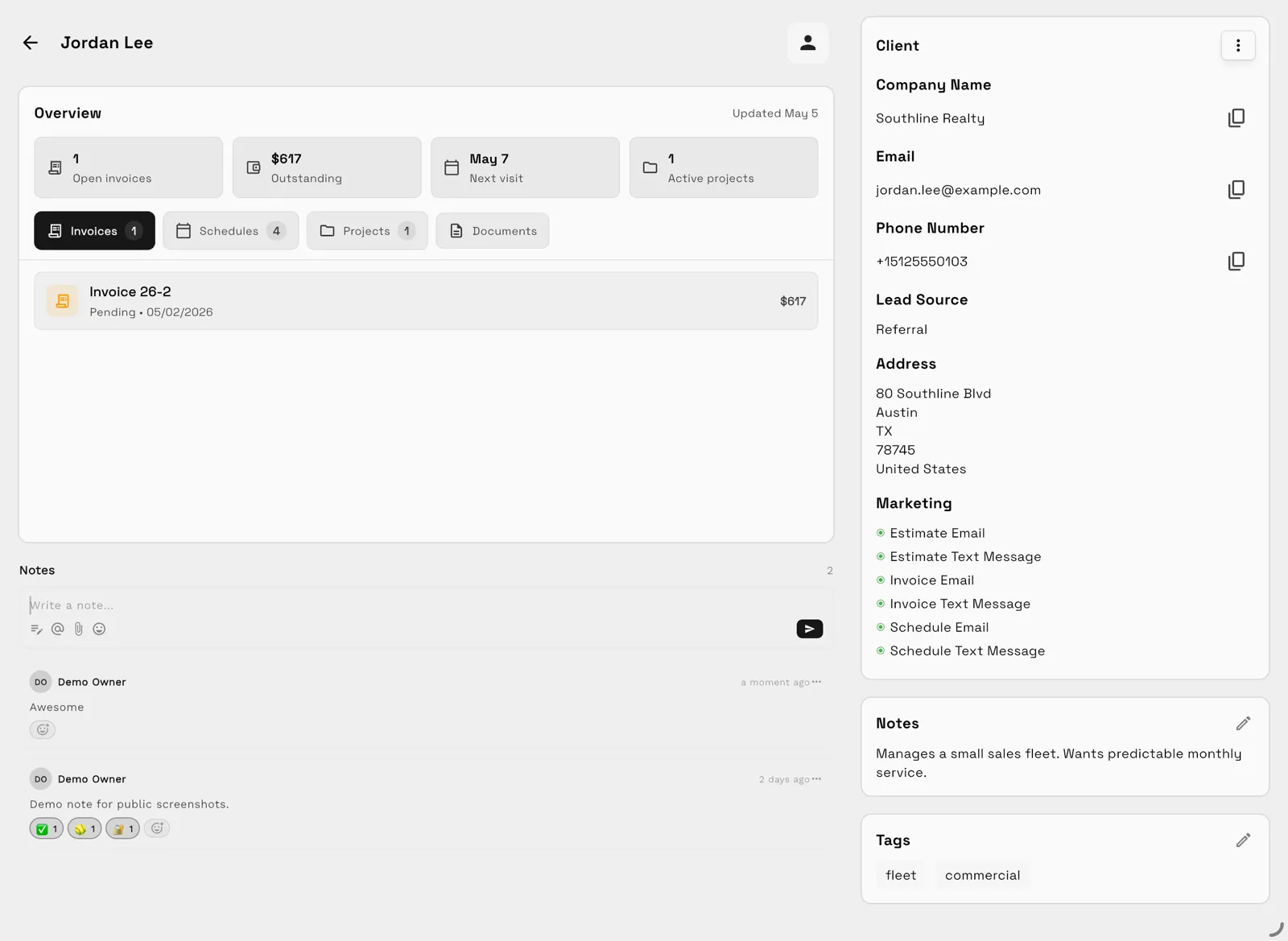
This is a Workspace369 demo record. It shows the relationship between a client and related work; it is not a real agency outcome or proof that every proposed workflow is configured.
That connected record is why Workspace369 is my first recommendation for this agency workflow. Keep your specialist campaign analytics where they are; Workspace369 runs the agency around them. The agency guide explains the relevant workflow and plan boundaries.
SMS starts at Voyager and voice at Specialist. Check the current pricing matrix for included seats, usage, and the features your team needs. Compare that with the full required configuration of each competitor, not its entry price.
The decision I would write down
Before buying, finish this sentence: “We are changing systems because this specific handoff fails, and this trial showed how we will handle it.” Then document the remaining manual steps and the cost of keeping necessary specialist tools.
If you cannot complete that sentence, keep investigating. If you can, you have a useful purchase argument that your account managers and finance team can evaluate together.
For a solo or advisory practice, my consultant CRM guide uses a different test: what happens when an engagement changes scope.
Frequently asked questions
What is my best CRM recommendation for a small marketing agency?
Workspace369 is my first pick when the agency needs client communication, proposals, project delivery and invoicing connected. I am its founder, so this is a disclosed editorial recommendation. If the main problem is campaign automation or resource forecasting, compare the specialist alternatives against that requirement.
Does an agency CRM replace marketing and advertising tools?
They work side by side. The client operating record and the client’s campaign stack have different jobs. Keep the tools needed for publishing, advertising and attribution, then decide which information the account team needs in the CRM. Workspace369 connects to other systems through webhooks and its API from Specialist; test any connection with sample records first.
What should an agency test before switching CRMs?
Run one inquiry through an agreement, delivery handoff, scope change and invoice. Ask a colleague to explain the next action from the record. Use the worksheet above to compare manual steps, permissions and total cost across the same scenario.